
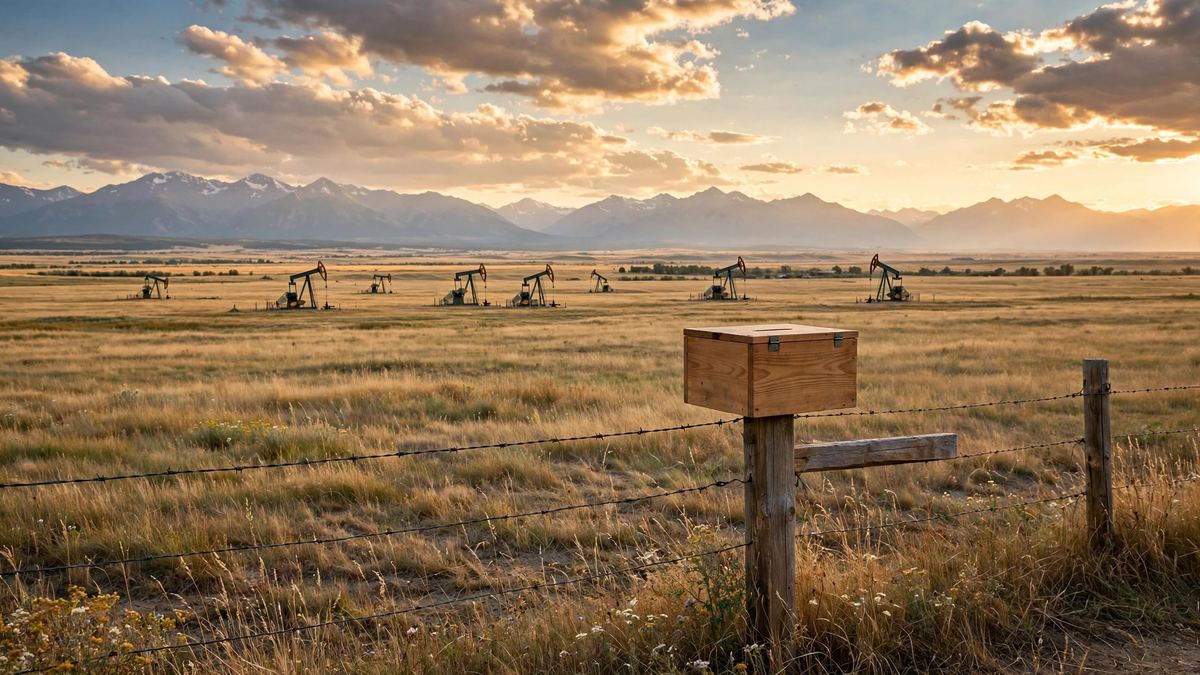
On 19 October 2026, voters in Alberta will take part in a vote unlike any other in recent Canadian history. They will not be deciding whether their province leaves Canada. Instead, they will be voting on whether Alberta should begin the legal process that could lead to a future binding referendum on separation. Think of it as a referendum on holding a referendum — a non-binding vote about a binding vote, years in the making and driven by a citizen petition that gathered more than 300,000 signatures.
For a province of around 4.7 million people — oil-rich, economically powerful, and long at odds with the federal government in Ottawa — the vote is both a safety valve and a signal. This article explains the background, the mechanics, the federal response, and what could happen after the ballots are counted.
Background: Alberta's economy and its grievances with Ottawa
Alberta is Canada's energy heartland. The province sits on vast reserves of oil and natural gas, and resource development has shaped its identity, its politics, and its prosperity for generations. Calgary is the corporate home of much of the country's energy sector, while cities such as Edmonton anchor a broader economy of agriculture, technology, and services.
That dependence on energy has also produced long-standing friction with Ottawa. Provincial leaders and many Albertans argue that federal environmental policies have limited resource development — restricting pipelines, adding regulatory costs, and slowing projects the province sees as vital to its future. A second, equally durable grievance concerns federal offset and equalization-style payments: the idea that Alberta contributes far more to the national treasury than it gets back, subsidizing other provinces while its own priorities go unaddressed. These complaints are not new, but they have deepened in recent years, and they form the political fuel behind the current vote.
It is worth noting that Alberta's energy position also shapes national conversations beyond separation. The province's abundant electricity and land have made it central to debates about large new power-hungry projects, including Canada's data-centre boom, where questions about who controls resource development and who benefits from it resurface again and again.
What happened: the petition and the Premier's sanction
The road to the October 19 vote began with a citizen petition. Proponents of a separation vote collected more than 300,000 signatures — far above the roughly 178,000 signatures needed under provincial rules to put a question before voters. It was an unusually large show of organized support, and it placed the issue squarely on the political agenda.
On 21 May 2026, Premier Danielle Smith formally sanctioned the process, announcing that Albertans would be given their say. Her decision framed the vote as a democratic response to the petitioners' effort: hundreds of thousands of people had signed, and the government, she argued, could not simply ignore them.
Smith's own position has been carefully stated and is an important part of the story. She has said she personally supports Alberta remaining in Canada — that her own vote would be for staying — while maintaining that the question deserves to be asked because the public demand is real. She has also said that if the remain side wins on October 19, she will not hold another referendum on separation, a commitment intended to give the vote finality.
What exactly is on the ballot
The question voters will face presents a choice: that Alberta remain a province of Canada, or that the provincial government commence the legal process required under the Canadian Constitution to hold a binding provincial referendum on whether Alberta should separate from Canada.
Read carefully, and the distinction is clear. A "yes" vote to the second option does not make Alberta independent. It does not trigger secession, it does not break up Canada, and it has no direct legal effect on the Constitution. What it does is give the provincial government a democratic mandate to start the long, complex legal journey toward a future binding vote — consulting lawyers, testing the question against federal law, and navigating constitutional requirements.
This is why observers describe it as a "referendum on holding a referendum." It is a measure of public will, not a declaration of independence. The distinction matters enormously, because Canadian law — and the federal government's position — draws a sharp line between asking an advisory question and actually seceding.
Why it matters: Ottawa's response
The federal government, led by Prime Minister Mark Carney, has reacted sharply. Carney called the planned vote a "dangerous bluff" and compared it to Brexit — the 2016 United Kingdom referendum on leaving the European Union. The comparison carried a personal edge: Carney was governor of the Bank of England during the Brexit vote, and he has positioned himself as someone who has seen firsthand how a referendum campaign can unleash consequences its organizers did not intend.
Ottawa is not relying on rhetoric alone. Carney's government is examining whether the referendum question is consistent with the Clarity Act, the federal law passed in 2000 that sets the ground rules for any province seeking to secede. That review signals that the federal government views the vote as more than political theatre — it is testing, in advance, where the legal boundaries lie.
The federal posture reflects a broader national stake. Resource policy is a shared jurisdiction where Ottawa and the provinces frequently collide, and federal agreements — from energy regulation to international partnerships such as the Canada–Australia critical minerals pact — are negotiated with the assumption that Canada's provinces, including Alberta, remain part of the federation. A province openly contemplating departure complicates that assumption, even when the vote itself is non-binding.
The Clarity Act, explained
Passed in 2000 in the aftermath of Quebec's two sovereignty referendums (1980 and 1995), the Clarity Act is Ottawa's legal framework for secession votes. Its core principles are straightforward:
- A clear question. The House of Commons must determine that the referendum question is clear — a direct question about secession, not a vague or multi-part proposition.
- A clear majority. The Act requires a "clear majority" in favour of secession on a clear question. It deliberately does not define a specific percentage, leaving the House of Commons to assess whether the result is decisive enough.
- A federal obligation to negotiate. If a province votes with a clear majority on a clear question, the federal government is obliged to enter into negotiations on secession — negotiations that would involve all provinces, Indigenous peoples, and a host of constitutional questions.
Crucially, none of this is triggered by the October 19 vote. The Alberta question is not a binding secession vote, so the Clarity Act's machinery does not automatically engage. But the Act looms over everything that follows: any future binding referendum on separation would have to survive exactly this scrutiny, and Ottawa's current review of the October question is an early test of how strictly the federal government intends to apply it.
What supporters and critics say about the process
The petitioners behind the vote argue that the Clarity Act sets an unfairly high and deliberately vague bar — that "clear majority" without a number gives Ottawa a veto over a democratic result. Federal officials counter that the Act exists precisely to prevent a province from drifting out of the country on an ambiguous question and a narrow margin. The Premier sits between these poles: supporting the right to ask, while personally backing the remain side.
What happens next: scenarios for a yes or a no
The vote's outcome will shape Alberta's politics for years, but neither result produces independence — and both leave hard questions unanswered.
If the "remain" side wins
A victory for remaining in Canada would be a powerful statement: that even in a province with deep grievances against Ottawa, a majority prefers to work within the federation. Smith has said she will not hold another referendum on separation in that event, which would close the door on the current process. Attention would then shift to whether Ottawa responds to the underlying grievances — on energy policy, regulatory costs, and fiscal transfers — that brought the province to the brink of this vote in the first place. History suggests that such grievances do not vanish with a single ballot; they tend to resurface in different forms.
If the "begin the process" side wins
A win for commencing the legal process would be historic: the first time a Canadian province outside Quebec voted to advance toward a binding separation referendum. The practical effects, however, would unfold slowly. The provincial government would begin the constitutional and legal work — drafting a question, testing it against the Clarity Act, consulting with Indigenous groups whose treaty rights would be directly affected, and preparing for a binding vote that could be years away. Ottawa would almost certainly challenge aspects of the process, and every step would be litigated in courts and debated in Parliament. Secession itself would remain a distant, uncertain prospect even after a yes vote.
The longer view
Whatever the result, the October 19 vote marks a turning point in the relationship between Western Canada and Ottawa. It has already drawn international attention — Canada is in the global spotlight this month for several reasons, from energy politics to separate headlines such as the Canada–Saudi Arabia travel warning — and the referendum will be watched abroad as a test of how modern federations manage internal dissent.
For students of politics, the vote is a live case study in how democracies channel regional discontent: through petitions, through advisory votes, through legal frameworks like the Clarity Act, and through the choices of leaders who must balance a restive base against national unity. On October 19, Albertans get to speak. What the rest of Canada does with their answer is the next chapter.
The vote is now in: Albertans rejected secession, with 76% voting to stay in Canada.
Sources
Reporting drawn from BBC, Associated Press, CityNews (October 2026).