
Trump robotics tariffs were not imposed on 28 October 2026, even though President Donald Trump signed a proclamation agreeing with a finding that imports of robotics, industrial machinery and parts threaten to impair national security. Instead of immediate duties, the proclamation set in motion a 180-day period of negotiation with trading partners. That distinction is the most important fact for manufacturers, buyers and workers trying to understand the decision. A national security finding has been made, but the choice of tariffs, quotas, fees or incentives has been deferred while talks take place. If those talks fail, or if agreements prove ineffective, trade restrictions may follow. If they succeed, the outcome could be very different from the tariffs many observers had expected.
The decision followed a long investigation. The probe was opened in September 2025, more than a year before the proclamation, under Section 232 of the Trade Expansion Act of 1962. Section 232 is a United States law that allows the president to act when imports are found to threaten national security. The process typically involves an investigation by the Commerce Department, a report and recommendations, and then a presidential decision on whether and how to act. In this case, the Commerce Department found that imports of robotics, industrial machinery and parts threatened to impair national security, and the president agreed with that finding. Agreement with the finding, however, did not automatically mean tariffs on the same day. The proclamation directed a different next step: negotiation.
Trump robotics tariffs: what the proclamation decided
The proclamation directed Commerce Secretary Howard Lutnick and United States Trade Representative Jamieson Greer to negotiate agreements with trading partners and to report back in 180 days. That instruction gives negotiators a defined window to seek deals that address the concerns identified in the investigation. The possible outcomes after that window are broad. The proclamation states that if talks fail or agreements prove ineffective, tariffs, quotas, fees and domestic-production incentives may follow. Tariffs are taxes on imports that raise their price. Quotas limit the quantity that can be imported. Fees can add a charge on imported goods. Domestic-production incentives are measures designed to encourage production inside the United States, for example through support for factories, research or workforce training. Listing all four options signals that the administration is keeping a wide range of tools available, rather than committing in advance to a single rate or restriction.
For businesses, a 180-day negotiation window creates both time and uncertainty. Time, because no new tariff takes effect immediately and existing supply arrangements can continue while talks proceed. Uncertainty, because the eventual outcome depends on negotiations that have not yet taken place and on judgements about whether agreements are effective. Manufacturers that use robots and industrial machinery in their factories will want to know whether the cost of imported equipment will rise, whether delivery times will change, and whether alternative suppliers in the United States or in partner countries can meet their needs. Suppliers abroad will want to know whether they can reach agreements that preserve market access. Investors will watch for signals about which countries and products are covered by talks and whether any early agreements emerge. None of those questions can be answered fully until the negotiations produce results or the 180 days expire.
What Section 232 means and what is covered
Section 232 investigations are different from ordinary trade disputes about price or market access. They focus on national security, broadly understood to include not only military capability but also the health of industries considered essential to defence and economic resilience. A finding that imports threaten to impair national security can therefore rest on arguments about dependence on foreign suppliers, loss of domestic manufacturing capacity, control over critical technology, and vulnerability to disruption or coercion. Critics of Section 232 action sometimes argue that the concept of national security is applied too broadly, while supporters argue that dependence on foreign suppliers for essential equipment is itself a security risk. The robotics decision sits within that wider debate, and its outcome will be judged by how the security arguments are weighed against the costs to businesses and consumers.
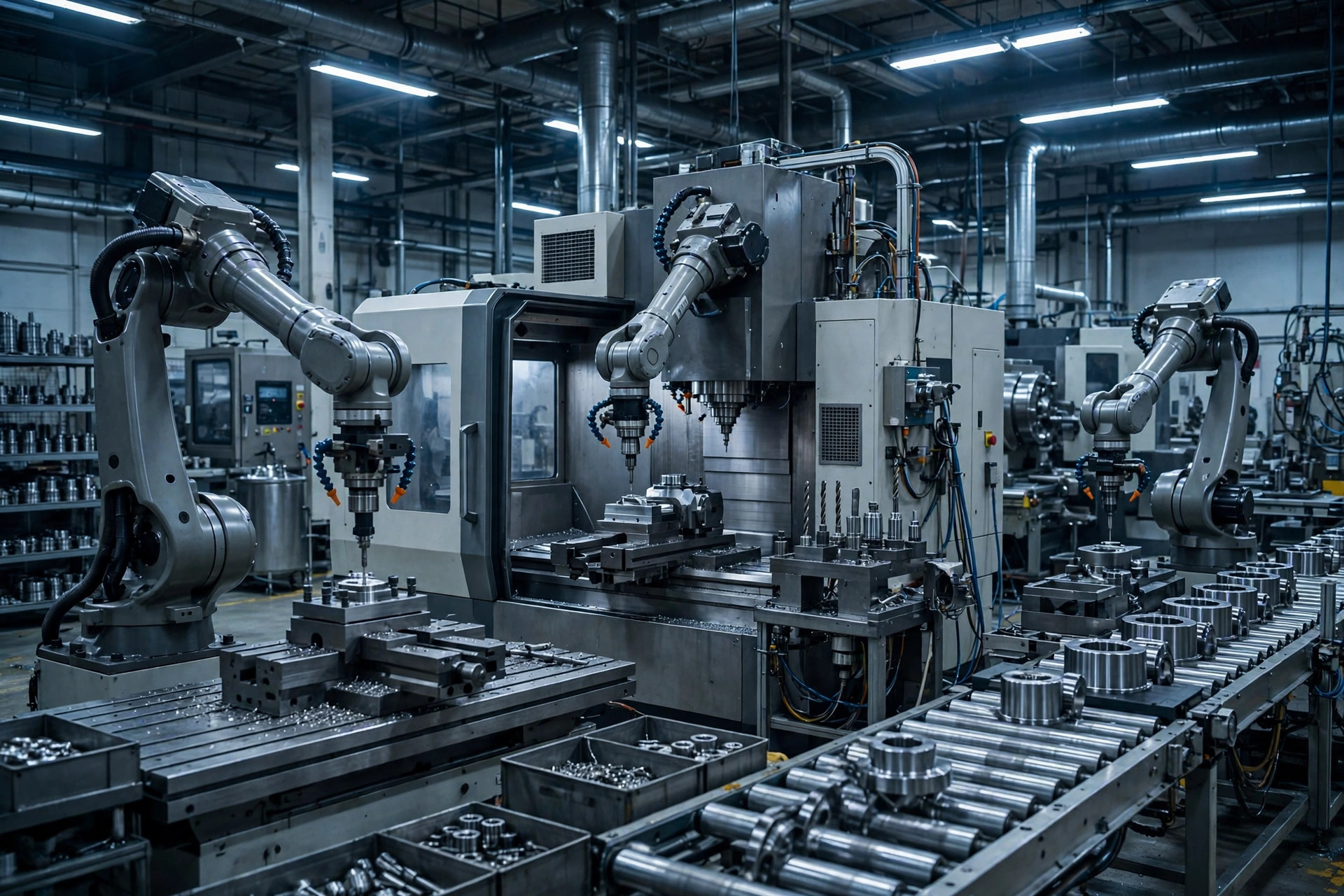
The goods covered by the finding are wide-ranging. They include programmable computer-controlled mechanical systems, machine tools for cutting, welding and handling workpieces, industrial stamping and pressing machines, autoclaves, industrial ovens, and laser and water-cutting tools and machinery. In plain terms, the list covers many of the machines that modern factories use to make, shape, cut and treat products, as well as the robotic systems that move, assemble and handle materials. These are not consumer gadgets. They are capital goods: expensive, long-lived equipment that businesses buy to produce other goods. Changes in their price or availability can therefore ripple through manufacturing supply chains, affecting the cost of cars, electronics, machinery and many other products. The breadth of the list also explains why the negotiation window matters. A tariff applied across all of these categories at once would affect a large part of manufacturing, while negotiated agreements could in principle be tailored by country, product or commitment.
The Commerce Department's reasoning, as reported, was that the United States relies on foreign imports for most robotics and industrial machinery and that domestic capacity is insufficient. That claim goes to the heart of the security argument. If a country cannot produce enough of the machines it needs to run its factories, it may be vulnerable if foreign supply is interrupted, restricted or used as leverage. Building domestic capacity takes time, investment and skilled workers, and it cannot be achieved by a tariff alone. That is one reason the proclamation also mentions domestic-production incentives as a possible follow-up measure. Incentives aim to address the underlying capacity gap, while tariffs and quotas aim to change the terms on which foreign goods enter the market. The balance between those approaches will be a central question in the months ahead.
Trump robotics tariffs and the security concerns behind them
Security concerns about robots go beyond manufacturing dependence. The Commerce Department and other agencies have raised concerns that robots collect data that could be used to surveil, aid foreign intelligence, or remotely commandeer robots. Modern robots are not simply mechanical arms. They are connected systems with cameras, sensors, software and network links. They collect information about their surroundings to navigate, avoid obstacles and perform tasks. That data can be sensitive if a robot operates in a factory, warehouse, hospital or public space. The concern is that data collected by a robot could be accessed remotely, or that control of the robot itself could be taken over, with consequences for safety, privacy and security. These concerns are not unique to robots, but robots combine mobility, sensing and physical action in a way that makes control and data issues particularly important.
A related step had already been taken in July 2026, when the Federal Communications Commission, usually called the FCC, barred imports of new models of Chinese robots and power inverters. Existing humanoid and quadruped models may still be imported under that decision, a distinction that matters for buyers who already use those models. Power inverters are devices that convert electrical power, and they are important in energy systems including data centres. Analysts expect demand for humanoid robots and for data-centre inverters to grow, which helps explain why the robotics and machinery investigation attracted attention beyond specialist trade circles. The FCC action and the Section 232 finding are separate measures, taken by different bodies for different reasons, but they point in a similar direction: closer scrutiny of connected machines and components that combine foreign manufacture with data and control capabilities.
It is important not to confuse the robotics decision with a separate set of tariffs on drones. Earlier, in August 2026, the administration imposed tariffs on unmanned aerial systems, usually called drones or UAS, at 100 percent on larger or more sensitive drones and 25 percent on smaller drones. Drones and ground-based robots share some technologies, including sensors, batteries and software, but they are different categories of product with different uses and different trade measures. The October proclamation on robotics and industrial machinery did not impose those drone rates on robots. Keeping the two decisions separate helps readers avoid overstating what has been decided: drones faced immediate tariffs in August, while robotics and industrial machinery face a finding, a negotiation window, and a decision to be made later.
Trump robotics tariffs and the wider economic context
The robotics decision arrived during a period of intense attention to technology, manufacturing and interest rates in the United States. Large technology companies were reporting results that shaped expectations for artificial intelligence, cloud computing and automation, as reflected in coverage of Microsoft and Alphabet earnings in October 2026. At the same time, monetary policy was in focus, with the Federal Reserve holding interest rates after a divided vote, as explained in coverage of the Fed holding interest rates in October 2026 by a 10-2 vote. Interest rates affect the cost of borrowing for factories, equipment purchases and investment in automation, so they form part of the background against which businesses judge whether to buy robots now, wait, or invest in domestic alternatives. Global capital markets were also active, including a high-profile listing debut in India covered in reporting on the Jio Platforms share price of 1358 on listing debut at a 21 percent premium in 2026. None of these events determines the robotics outcome, but together they show a business environment in which technology investment, borrowing costs and global listings are all moving at once.
For manufacturers, the practical questions in the negotiation window are concrete. They include whether to bring forward purchases of machinery before any future restriction, whether to seek suppliers in countries likely to reach agreements, whether to invest in maintenance and upgrades for existing equipment rather than new purchases, and whether to explore domestic suppliers that might benefit from incentives. Each choice involves cost and risk. Buying early can avoid a future tariff but ties up capital and storage. Waiting can preserve flexibility but risks higher prices later. Seeking new suppliers takes time to test, certify and integrate equipment. Businesses will therefore look closely for early signs from the negotiations: which partners are engaged, what kinds of commitments are discussed, and whether any interim agreements are announced before the 180 days end.
What happens next for manufacturers and buyers
The formal next step is negotiation. Lutnick and Greer are to negotiate agreements with trading partners and report back in 180 days. That report will be a key moment. It will show whether agreements have been reached, whether they are judged effective, and what further action is recommended. If agreements are judged effective, the administration may decide that no tariffs or quotas are needed, or that narrower measures are sufficient. If talks fail or agreements prove ineffective, the administration may move to tariffs, quotas, fees, domestic-production incentives, or a combination of them. The 180-day period from 28 October 2026 therefore sets a timetable for businesses and governments to work to, even though the exact end date and the form of any follow-up will depend on how negotiations proceed and on the report that follows them.
Readers should also watch for distinctions in any future measures. A tariff rate, if one is eventually chosen, will matter greatly, as will the list of products and countries covered, any exemptions, and the date from which it applies. A quota will matter in a different way, because it limits quantity rather than raising price directly, and can create shortages if demand exceeds the allowed quantity. Fees and incentives will matter for the longer-term shape of domestic production. Until those details are announced, the most accurate description of the position is the one set out in the proclamation itself: a national security finding has been made, no immediate tariffs have been imposed, negotiations will take place over 180 days, and further measures remain possible if talks do not produce effective agreements. That careful wording reflects a decision that is significant without yet being final, and it leaves the most consequential choices still to be made.
The Trump robotics tariffs negotiation window also gives trading partners time to explain how their exports support United States manufacturing. Robots and machine tools are inputs to production, not only finished goods, so partners may argue that secure, affordable supply helps American factories compete, while the United States may seek commitments on data, security and domestic capacity.
Until the 180-day report arrives, the Trump robotics tariffs position remains a finding without immediate duties. Manufacturers should plan for several outcomes, from negotiated agreements that preserve access to tariffs, quotas or incentives if talks are judged ineffective.
Businesses watching the Trump robotics tariffs process should therefore track the negotiation timetable, any interim agreements, and the eventual report, rather than assuming that the absence of immediate tariffs means no measures will follow.
- President Trump signed a proclamation on 28 October 2026 agreeing with a Commerce Department Section 232 finding on robotics, industrial machinery and parts.
- No immediate tariffs were imposed; Lutnick and Greer must negotiate with trading partners and report back in 180 days.
- If talks fail or agreements prove ineffective, tariffs, quotas, fees and domestic-production incentives may follow.
- Covered goods include programmable computer-controlled systems, machine tools, stamping and pressing machines, autoclaves, industrial ovens, and laser and water-cutting tools and machinery.
- The probe opened in September 2025; the FCC barred imports of new models of Chinese robots and power inverters in July 2026; separate drone tariffs were imposed in August 2026.
The robotics decision is therefore best understood as the start of a process, not its end. The security finding sets the direction, the negotiation window sets the timetable, and the report in 180 days will set the terms of the next decision. Businesses, trading partners and policymakers now have time to negotiate, prepare and argue their cases, but they also face uncertainty about what will happen if those negotiations do not succeed.
Sources: Reuters, White House, Bloomberg, October 2026.