
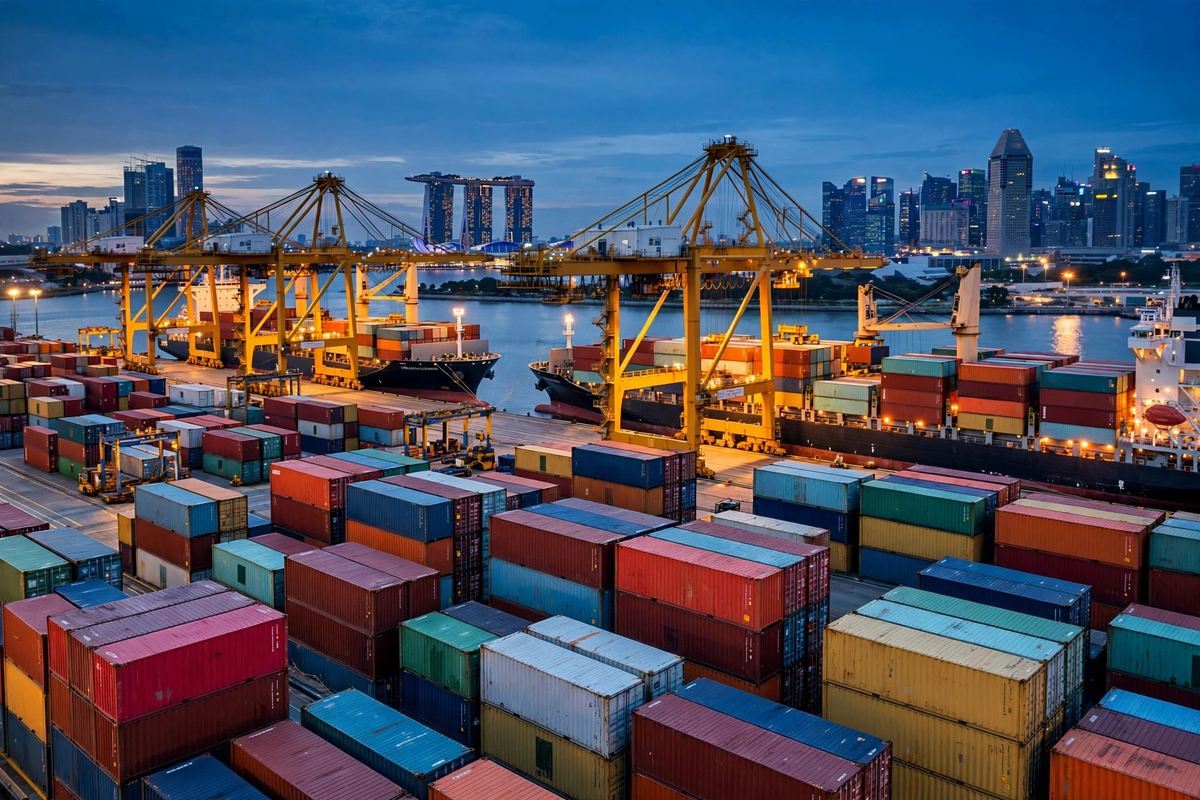
Singapore's exports delivered a stunning surprise in September 2026, with non-oil domestic exports jumping 68.4 per cent from a year earlier, more than double what economists had forecast. The figures, released by Enterprise Singapore on 16 October, showed a sharp acceleration from August's already strong revised growth of 46.1 per cent. The result beat the median forecast of 32.2 per cent growth in a Reuters poll by a wide margin, and exceeded the 32.4 per cent growth tipped in a Wall Street Journal poll. It was the sixth straight month of growth above 20 per cent, and it added to an already strong year in which non-oil domestic exports rose 27.6 per cent across the first nine months of 2026. For a small, trade-dependent economy, a number of this size is not just a statistical curiosity; it is a signal about the health of global demand, the artificial intelligence boom, and the quirks of measuring trade in a single month.
To understand the headline, it helps to know what non-oil domestic exports, known as NODX, actually measure. NODX tracks the value of goods produced in Singapore and exported abroad, excluding oil and re-exports of goods that merely pass through the port. It is one of the most closely watched indicators of Singapore's economic health, because exports are the lifeblood of the city-state. Singapore has almost no natural resources and a small domestic market, so its prosperity depends on selling goods and services to the rest of the world. NODX is divided into two broad categories: electronics, which includes semiconductors, disk media products, personal computers and other technology goods; and non-electronics, which includes everything from pharmaceuticals and petrochemicals to ship structures and specialised machinery. Both categories surged in September, but for different reasons.
Electronics exports rose 107.6 per cent from a year earlier in September, more than doubling. That is an extraordinary rate of growth, although it was actually slower than August's revised increase of 131.6 per cent. The driver, according to Enterprise Singapore, was robust demand linked to artificial intelligence. The AI boom has created enormous demand for the building blocks of computing: integrated circuits, memory chips, disk media products, and the servers and personal computers that run AI software. Singapore is a key node in the global semiconductor supply chain, with chip manufacturing, assembly, testing and logistics operations that feed into the products of major technology companies. When global demand for AI hardware surges, Singapore's electronics exports surge with it. The September figures suggest that the AI hardware cycle, which has been running for more than a year, is still accelerating.
Non-electronics exports rose 54.2 per cent, a sharp acceleration from August's revised 11.9 per cent increase. The main driver here was more unusual: what Enterprise Singapore described as lumpy exports of structures of ships and boats. In plain language, that means a small number of very large, very expensive items, such as offshore platforms, ship sections or marine structures, were delivered and recorded as exports in September. Such shipments are irregular: they do not occur every month, and when they do, they can distort the headline figure. That is why economists caution against reading too much into a single month's NODX data. The underlying trend, excluding these lumpy items, is still strong, but not quite as spectacular as the 68.4 per cent headline suggests. Gold and specialised machinery also contributed to the non-electronics increase.
The geographic pattern of the surge is also informative. Shipments rose to nine of Singapore's top ten markets. Exports to Hong Kong rose 112.1 per cent, to Taiwan by 96.9 per cent, to South Korea by 96.0 per cent, and to the United States by 73.2 per cent. Exports to China rose 36.8 per cent, and to the European Union by 11.3 per cent. Shipments to India declined. The strength across Asia reflects the region's central role in the semiconductor and electronics supply chain: chips made in one country are assembled into products in another, and Singapore sits at the crossroads of those flows. The strong growth in exports to the United States, despite trade tensions and tariffs, suggests that American demand for technology goods remains robust, and that Singapore's position as a reliable supplier has not been undermined by the shifting trade landscape.
The export surge came at an interesting moment for Singapore's broader economy. Advance estimates had shown that Singapore's economic growth slowed in the third quarter of 2026, but still exceeded expectations. The trade figures, coming after that slowdown, suggest that the external sector remains a source of strength even as domestic activity cools. In August, Enterprise Singapore upgraded its forecast for full-year NODX growth to a range of 14 to 16 per cent, from 3 to 5 per cent. The September figures, if sustained, would put the full-year outcome well above even that upgraded range. However, economists caution that the lumpy ship-structure shipments are unlikely to repeat every month, and that the electronics surge, while real, is coming off a base that will become harder to beat as the year progresses.
There are also risks on the horizon. The ongoing conflict in the Middle East poses risks to the broader trade outlook, both through higher energy prices and through disruption to shipping routes. Tariffs and trade tensions between the United States and China remain a source of uncertainty for an economy that depends on open trade. The AI boom, which is currently driving electronics demand, could cool if investment in AI infrastructure slows, or if the returns on AI spending disappoint. Memory prices, demand for advanced packaging, and AI server orders will offer clues to the direction of exports in the coming months, according to analysts at OCBC. For now, though, the September data are a reminder of how powerfully the AI cycle is reshaping global trade, and of Singapore's ability to benefit from it.
What does the surge mean for ordinary Singaporeans? In the short term, strong exports support jobs in manufacturing, logistics, shipping and related services, and they contribute to government revenue. They also support the Singapore dollar and help keep the economy resilient. In the longer term, the figures raise questions about sustainability. An economy that depends heavily on a single cycle, whether AI hardware or ship structures, is vulnerable when that cycle turns. Singapore's policymakers have long sought to diversify the economy, including by developing services, biotechnology and green technology. The September figures do not change that imperative, but they do provide a welcome buffer at a time of global uncertainty.
What happens next will be revealed in the coming months' data. If October and November show continued strong growth, even without the lumpy ship shipments, it will confirm that the AI-driven electronics boom has durable momentum. If the figures fall back sharply, it will suggest that September was an outlier driven by one-off factors. Either way, the September surge is a striking data point in the story of how artificial intelligence is reshaping the global economy, and how a small island nation at the crossroads of Asian trade continues to punch far above its weight.
Related reading: Singapore's central bank holds policy
Related reading: Japan wholesale inflation and BOJ rate hike
Pay is moving alongside trade, with Singapore's wage council calling for 6–8% pay rises for lower-wage workers.
At the exchange, a leadership transition is under way: SGX is planning for CEO Loh Boon Chye's succession ahead of 2027.