
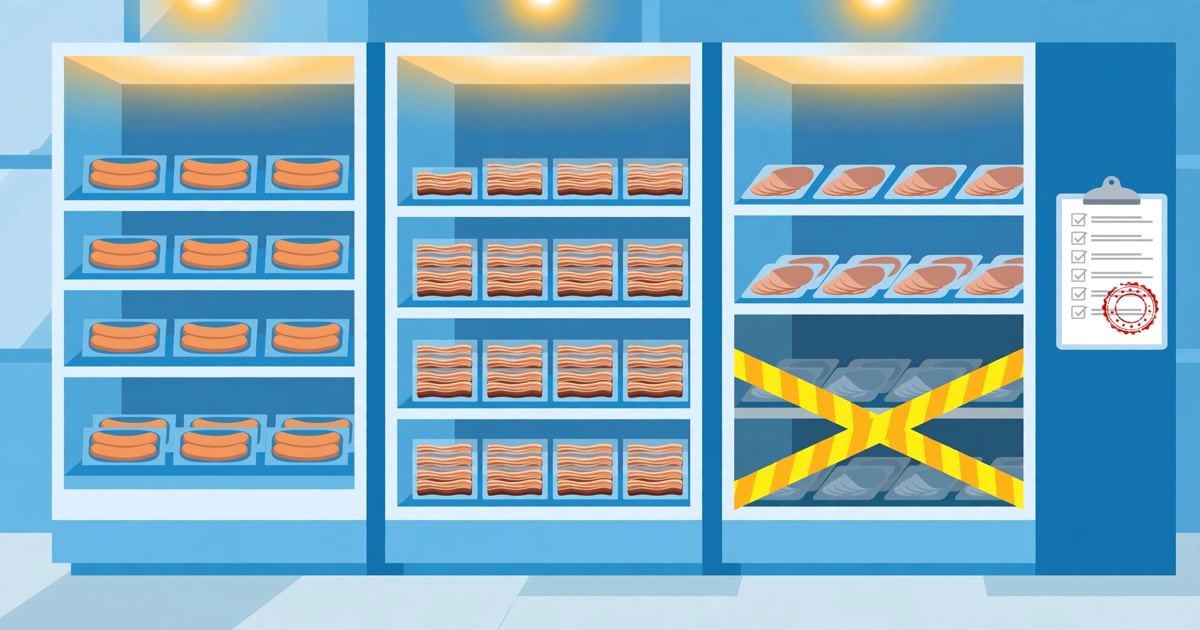
CHELSEA, MASSACHUSETTS — One of the largest food recalls of the year is now underway in the United States. Kayem Foods Inc., a family-owned craft meat business based in Chelsea, Massachusetts, is recalling about 1,584,361 pounds of ready-to-eat meat and poultry products because they may have experienced temperature abuse during storage, the U.S. Department of Agriculture's Food Safety and Inspection Service (FSIS) announced on 17 October 2026. The recall covers hot dogs, bacon, sausage, turkey breasts, hams and other ready-to-eat products sold under nine brands, shipped to retail and foodservice locations across the United States and to Hong Kong. The story is trending per news coverage, with searches for the recall surging on Google Trends.
FSIS classified the action as a Class I recall — its highest-risk category — and said it is concerned that some of the products, some of which have long shelf lives, may still be sitting in consumers' refrigerators or freezers. No confirmed illnesses have been reported, officials said, but anyone who finds a recalled product at home is urged not to eat it and to throw it away or return it to the place of purchase.
What exactly is being recalled
The recall is unusually broad. It covers more than 100 individual products — all ready-to-eat (RTE) meat and poultry items produced from approximately 31 March 2026 through 7 October 2026. The affected products include hot dogs and frankfurters, bacon, sausage, oven-roasted turkey breasts and hams, sold under the following brand names: Kayem, Genoa, Al Fresco, Triple M, McKenzin Country Classics, Deutschmacher, Jordan's, Essem and Winnisimmet.
Because Kayem manufactures products for multiple brands, the brand name on the package is not enough to determine whether an item is affected. Instead, consumers should look for the establishment numbers printed inside the USDA mark of inspection: EST. M/P 7839, EST. P 20935A or EST. M 9520. If any of those numbers appears on the package, the product is subject to the recall.
FSIS has published a complete list of recalled products with UPC code numbers and product label images on its recalls page at fsis.usda.gov/recalls. Consumers and foodservice operators should check their products against that list rather than relying on brand names alone. Retail distribution lists — showing which stores received the products — will be posted on the FSIS website when available.
How to check your fridge and freezer
The single most important step is a quick label check. Pull out packaged hot dogs, bacon, sausage, deli turkey and hams bought in the last several months — especially anything from the nine affected brands — and look inside the USDA inspection mark for the three establishment numbers above. Because some recalled items have long shelf lives, a product bought months ago could still be in a freezer.
If you find a match, do not eat the product — even if it looks and smells fine. FSIS advises throwing it away or returning it to the store where it was purchased. Washing or reheating the food is not a safe fix: the concern is temperature abuse during storage, which can allow harmful bacteria to grow and, in some cases, produce toxins that heat does not reliably destroy.
Consumers with questions can contact Kayem Foods customer service at 800-426-6100 or [email protected], Monday through Friday from 7:30 a.m. to 4 p.m. Eastern time. Anyone worried about an illness after eating a recalled product should contact a healthcare provider.
How the problem was discovered
The recall traces back to a single customer complaint. On 1 October 2026, a retail customer reported receiving product that was warm at the point of delivery. Kayem investigated and determined that various ready-to-eat meat and poultry products had been stored in a warehouse cooler that experienced temperature deviations.
Kayem's own statement, issued on 16 October, attributed the issue to a cooling-system malfunction at one of its warehouses. The company's description covers products stored and shipped between 7 June and 14 October, while FSIS lists an approximate production window of 31 March through 7 October 2026. The two date ranges describe different stages — production versus storage and shipping — and do not change the practical advice: check the establishment number and the UPC list.
FSIS was notified and announced the recall on Saturday, 17 October. The agency said it routinely verifies that recalling firms notify customers and take steps to remove affected products from commerce, and it monitors that process.
Why temperature abuse is taken so seriously
The term "temperature abuse" covers any situation in which refrigerated food is held above safe temperatures long enough for bacteria to multiply. For ready-to-eat products the stakes are higher than for raw meat, because these foods — hot dogs, deli turkey, pre-cooked bacon — are typically eaten without further cooking, so there is no final "kill step" to eliminate bacteria that grew during improper storage.
That is why FSIS gave this recall its Class I designation: the category is reserved for situations where there is a reasonable probability that eating the food will cause serious, adverse health consequences. It is the agency's strongest recall classification, and it is what triggered the urgent, nationwide notice even though no illnesses have yet been confirmed.
Cold-chain discipline is one of the least visible parts of the food system. Recent reporting on supermarket refrigeration failures showed how a breakdown in cooling can cascade through the food supply in hours. A single malfunctioning warehouse cooler, as in this case, can affect more than a million pounds of product before anyone notices — the warm delivery reported on 1 October was the first visible signal of a problem that had been developing quietly.
No illnesses reported so far
As of the recall announcement, FSIS said there had been no confirmed reports of illness linked to the recalled products. That is reassuring but not a reason to ignore the recall. Foodborne illness is often underreported, and some recalled products may still be uneaten in freezers, where the risk persists until the food is discarded.
Officials also note that the affected volume is large and distribution wide: more than 1.5 million pounds shipped to retailers and foodservice operations nationwide, plus shipments to Hong Kong. Foodservice distribution — restaurants, cafeterias, delis — means some recalled product may have been served to customers rather than sold at retail, which is why the FSIS retail distribution lists and the company's direct notifications to customers matter.
What happens next
FSIS said retail distribution lists will be posted on its recalls page when available, which will let shoppers see exactly which stores received affected products. The agency will continue monitoring Kayem's recall effectiveness — verifying that the company notifies its customers and removes product from commerce.
For consumers, the practical checklist is short: check the establishment numbers (EST. M/P 7839, EST. P 20935A, EST. M 9520) and the UPC list on fsis.usda.gov/recalls; discard or return any matches; and if you have already eaten a recalled product and feel unwell, contact a healthcare provider. The products to watch are everyday ones — the hot dogs, bacon and deli meats that fill millions of refrigerators — which is precisely why this recall, though technical in origin, has become one of the most searched food-safety stories of the month.
Sources: USDA FSIS recall announcement via Food Safety News (17 October 2026); USA Today (19 October 2026); MEAT+POULTRY (19 October 2026); weence.com recall summary (19 October 2026); Kayem Foods company statement via Cobb County Courier (19 October 2026); Google Trends 'Trending now' (19 October 2026).