
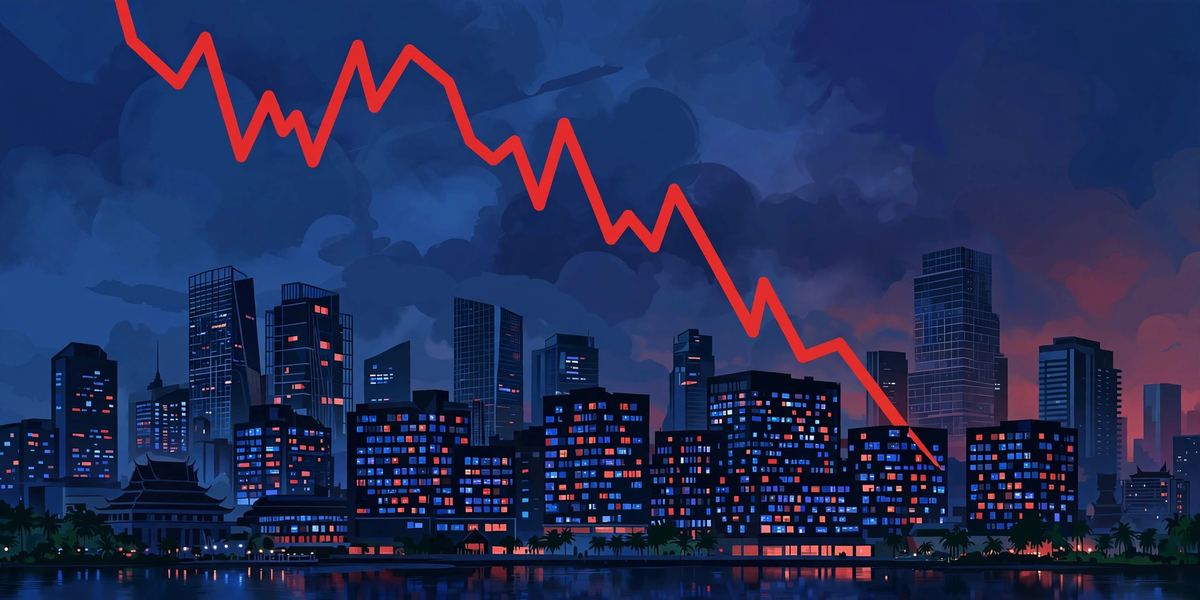
Indonesian stocks suffered their worst single-day fall in nearly three decades on Friday, 16 October 2026, after global index provider MSCI said it was consulting on removing Indonesia from its emerging-market indexes and reclassifying the country as a standalone market. The Jakarta Composite Index plunged more than 11 percent, triggering a trading halt, sending the rupiah lower, and raising fresh questions about transparency and governance in Southeast Asia's largest economy. The story is trending per news coverage, with Reuters, The Wall Street Journal and AFP among the outlets reporting the sell-off within hours.
The scale of the drop is what makes it historic. The benchmark opened about 8 percent lower, which triggered a 30-minute trading halt, and then extended its losses once trading resumed, falling as much as 11 percent and ending the session on track for its steepest one-day decline since January 1998, during the Asian financial crisis. The index also fell to its lowest level since 2020. With the day's losses, the Jakarta market is now down nearly 40 percent since the start of the year, making it one of the worst-performing stock markets in the world in 2026. The rupiah weakened to around 18,070 per US dollar, its lowest since early August and close to its lifetime low, and it remains Asia's worst-performing major currency so far this year.
What MSCI actually said
MSCI's announcement was a consultation, not an instant expulsion — but markets treated it as a serious verdict. In its statement, the index provider said that Indonesia's continued classification as an emerging market was "no longer appropriate" and that it was launching a consultation on a proposal to reclassify Indonesia as a standalone market. A standalone classification would exclude Indonesian equities from MSCI's main emerging-market indexes. That matters because trillions of dollars in passive investment follow those indexes: funds that track them would have to sell Indonesian holdings, and funds benchmarked against them would face pressure to do the same.
MSCI said investors had told it that "sufficient progress has not been observed consistently across the Indonesian equity market." It added that "significant concerns remain around market dysfunction, including continued suspected coordinated trading behaviour and lack of evidence of meaningful enforcement." In other words, the issue was not one bad day or one bad company. It was a judgment about how the market works — who really owns shares, whether prices reflect genuine buying and selling, and whether rule-breaking is punished.
Notably, MSCI also said that a reclassification to frontier-market status "would not properly recognise the depth of the market problems." That is a stronger statement than a routine downgrade. Frontier markets are a recognised category for smaller or less liquid markets. Standalone status is different: it sits outside the main emerging and frontier frameworks altogether. Argentina, Lebanon and Palestine are among the markets with that designation, and none is in Asia. If the proposal goes ahead, Indonesia would be the first Asia-Pacific market relegated to standalone status.
Why investors were already worried
The October announcement did not come out of nowhere. Earlier in 2026, MSCI had warned that it could downgrade Indonesia to frontier-market status, citing investability and transparency concerns. That warning alone sparked a market rout worth roughly $80 billion. Indonesian authorities responded with a package of reforms and said in April that the work had been completed, hoping to avoid a downgrade and to support the government's efforts to revive Southeast Asia's biggest economy.
The concerns at the heart of the dispute have been consistent. Investors had raised worries about "ongoing opacity in shareholding structures" — the difficulty of knowing who ultimately owns and controls listed companies — as well as coordinated trading behaviour that can distort price information. When ownership is opaque and trading looks coordinated, outside investors cannot be sure that a share price reflects what a willing buyer would pay a willing seller. They may also worry that small public shareholders are at a disadvantage against insiders and connected groups. MSCI's October statement effectively said that, despite the announced reforms, investors had not seen convincing, consistent evidence that these problems had been fixed, including evidence of enforcement when rules are broken.
That enforcement point is crucial. Announcing new rules is relatively easy. Demonstrating that they are applied — through investigations, penalties, suspensions, and transparent outcomes — is harder and slower. For an index provider that must decide whether a market is investable for global funds, the absence of visible enforcement can be as important as the rules on paper.
What the sell-off looked like on the day
The market reaction was fast and disorderly. An 8 percent fall at the open was enough to trigger a 30-minute halt, a circuit-breaker designed to give traders time to pause and reassess. When trading resumed, selling intensified rather than easing, pushing losses past 11 percent. The rupiah slid alongside equities, compounding the pressure: foreign investors who sell Indonesian shares must also convert rupiah proceeds back into dollars or other currencies, and a falling currency can amplify losses for anyone holding local assets.
Despite the severity of the Jakarta fall, the immediate spillover to other Asian markets appeared limited on the day. South Korean equities rebounded after a heavy loss in the previous session, while stocks in Taiwan and Singapore added about 1 percent each and Malaysian shares slipped modestly. That contrast underlines an important point: this was, at least initially, an Indonesia-specific shock driven by an Indonesia-specific judgment, not a region-wide panic. The risk is what happens next — whether sustained foreign outflows, weaker liquidity and damaged confidence turn a market event into a broader economic drag.
Analysts noted that Indonesia represents only about 0.43 percent of the MSCI Emerging Markets Index, which limits the direct global spillover from index exclusion. But the indirect effects can be larger than the index weight suggests. A standalone label can change how global investors think about a country: it can reduce research coverage, shrink the pool of funds willing to invest, raise the cost of capital for companies, and make it harder for the government to attract the long-term investment it wants for infrastructure, manufacturing and the energy transition. An 11 percent plunge alone is unlikely to destabilise Indonesia's financial system, analysts said, but sustained outflows could weaken liquidity, discourage investment and further erode confidence.
What standalone status would mean in practice
To understand the stakes, it helps to separate three things: the label, the mechanics, and the signal. The label is the classification itself — emerging, frontier or standalone. The mechanics are the index consequences: exclusion from the main emerging-market indexes means passive funds must sell, and many active funds that are measured against those indexes will reconsider their holdings. The signal is the reputational effect: a standalone designation tells the world that a major index provider does not currently regard the market as meeting the standards global investors expect.
For ordinary Indonesians, the effects are indirect but real. Pension funds and insurers that hold equities can see portfolio values fall. Companies may find it more expensive to raise money by selling shares, which can slow expansion and hiring. Banks and brokers face thinner trading volumes. And the government faces a harder task in convincing foreign investors that reforms are working. None of that is automatic or immediate — a consultation takes time, and a final decision is not expected until around June 2027, according to market commentary on the timeline. But markets price expectations early, and Friday's sell-off was a down payment on that uncertainty.
For global investors, the lesson is about the difference between size and investability. Indonesia is Southeast Asia's largest economy, with a large population, abundant natural resources and a growing consumer market. None of that is in doubt. What MSCI questioned was not Indonesia's economic potential but whether its equity market, as currently run, meets the transparency and enforcement standards that index membership implies. A big economy can still have a market that global funds find hard to trust.
What happens next
The consultation process gives Jakarta time to respond, and the coming months will be a test of whether reforms can be demonstrated, not just announced. Investors and MSCI will be watching for concrete evidence: clearer disclosure of ultimate ownership, credible action against suspected coordinated trading, transparent enforcement outcomes, and consistent application of the rules across the market. If authorities can show that progress, the final decision could still be softened. If they cannot, the standalone proposal could proceed, and the forced selling it implies would become a reality rather than a risk.
The episode also fits a wider pattern in 2026, in which global institutions have been pressing governments to confront fiscal and governance risks rather than assume growth alone will fix them. The IMF has warned that Asia's growth will slow in 2027 as energy shocks, AI disruption and higher yields bite, and Gulf markets have fallen as regional tensions and IMF warnings about a long war have weighed on sentiment. Against that backdrop, a governance-driven market shock in Indonesia is a reminder that investor confidence depends on institutions as much as on growth rates. You can read more in our coverage of the IMF's warning on Asia's growth outlook and the fall in Gulf stocks amid regional tensions.
Trade and investment flows add another layer. Indonesia is competing for the same global capital as other large emerging economies, including India, where a first phase of a US trade deal has been finalised and is in legal drafting. Capital goes where investors feel their money is safe, transparent and enforceable — and the MSCI consultation is, at its core, a judgment about whether Indonesia currently clears that bar. Our report on the India-US trade deal shows how policy credibility can shape investor sentiment in the opposite direction.
For now, the key dates are fixed: MSCI is accepting input on the proposal until 30 April 2027, and a decision is due no later than 30 June 2027. Until then, expect volatility: every reform announcement, enforcement action, or signal from MSCI will move prices, and every delay will be read as a sign that the problems are unresolved. The Jakarta market has fallen nearly 40 percent this year for reasons that go beyond one announcement. Friday's plunge was the market's verdict on whether those reasons have been addressed — and, for one day at least, the answer was no.
The sell-off did not end on Friday. On Monday, 19 October, Jakarta's benchmark fell over 5% to a six-year low after the 11.6% plunge on Friday, in what Reuters called a record two-day rout. The rupiah weakened to 18,048 per dollar, not far from the record low of 18,190 hit in June. The exchange halved its daily down limit to 7% to try to slow the selling, and Indonesia's financial regulator had on Friday unveiled fines totalling 2.1 trillion rupiah ($116.4 million) against those linked to alleged trading manipulation in shares of three firms.