
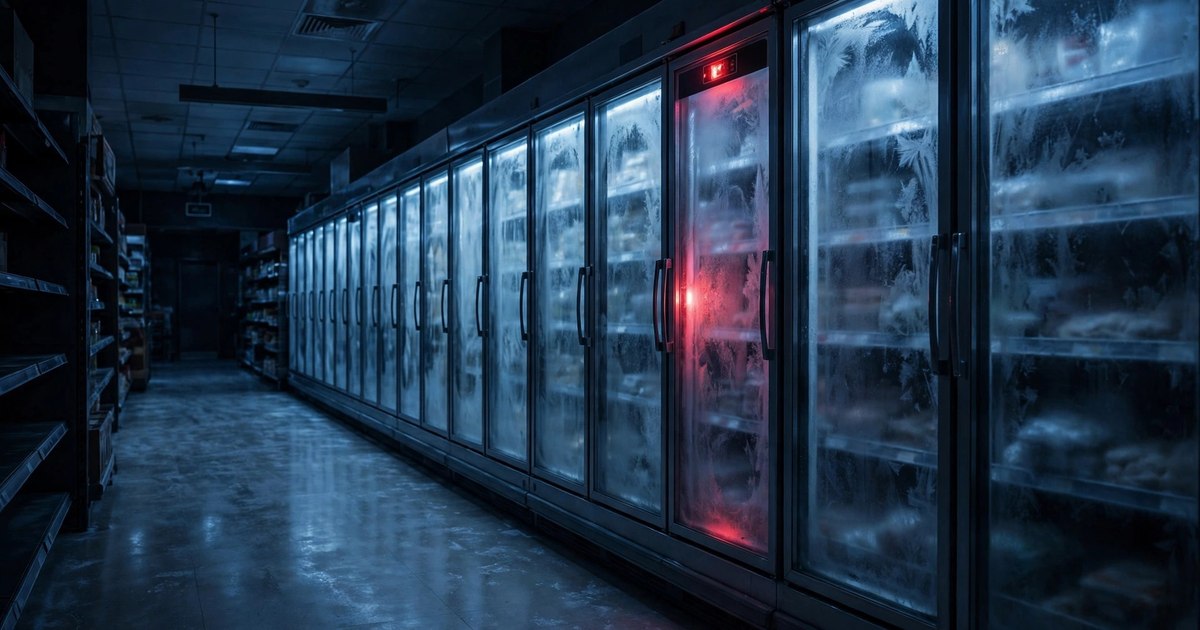
On 5 November 2026, five United States federal agencies issued a joint warning that hackers are breaking into the refrigeration systems that keep food, blood and medicine cold. The cold chain cyberattack campaign has already hit hundreds of supermarkets across Europe, three French blood bank sites and, US officials suspect, freezers at American military bases — and the agencies say every organisation that relies on refrigeration should assume it could be next.
What Is a Cold Chain Cyberattack?
The "cold chain" is the network of refrigerated trucks, warehouses, supermarket chillers and hospital freezers that keeps food and medicine at the right temperature from factory to shelf. A cold chain cyberattack targets the electronic controllers that run that equipment: the small computers that set temperatures, run defrost cycles and sound the alarm when something goes wrong. Instead of stealing data, the attackers change the settings. A freezer set to −30°C can be ordered to heat up. A chiller can be forced into a defrost cycle that never ends. The food spoils, the medicine warms, and the damage is physical rather than digital. That is what makes this campaign different from most cyberattacks. The target is not a database. It is a thermostat.
How Hackers Turn Supermarket Freezers Into Heaters
According to the joint advisory from CISA, the FBI, the Department of Health and Human Services, the Department of Agriculture and the Department of Transportation, the attackers are reaching refrigeration controllers that are exposed to the internet. Many of them still use the default passwords printed in the manufacturer's own documentation. Others run old firmware with known flaws. The advisory names three ways in: authentication bypass, arbitrary code injection and weak configurations. Once inside, the attackers can change temperature setpoints and force equipment into continuous heating and defrost cycles. They can also switch off the temperature monitoring, so nobody sees the warming until the food is already spoiled.
Much of the equipment at the centre of the attacks is made by the Danish company Danfoss. Its AK-SM 800 and AK-SC 355 controllers are legacy models — the AK-SM 800 reached end of life in May 2021 and the AK-SC 355 was phased out in 2016 — and many units no longer receive security updates. Danfoss fixed three flaws in its newer AK-SM 800A controllers in 2025, tracked as CVE-2025-41450, CVE-2025-41451 and CVE-2025-41452, covering an authentication bypass and command injection. But researchers at Claroty's Team82 found about 2,765 of these controllers still reachable from the public internet. On 13 October, Danfoss advised its Dutch customers to disconnect the systems from the internet. Most did. The ones that did not were hit in the second wave.
The Cold Chain Cyberattack Timeline: August to November 2026
Late August 2026: freezers fail at at least six US military commissaries — the grocery stores on American bases, including Fort Huachuca in Arizona, Fort Irwin in California and Naval Station Newport in Rhode Island. The Pentagon is treating the failures as a suspected cyberattack, but has not publicly confirmed that hackers caused them, and maintenance faults have not been formally ruled out.
Night of 11–12 October 2026: the first European wave. Hackers break into refrigeration controllers at hundreds of French supermarkets. Reuters reported that more than 350 establishments were affected, including Intermarché, Coopérative U, Carrefour Market, Monoprix, Leclerc and Super U stores. France's cybersecurity agency, ANSSI, publishes alert CERTFR-2026-ALE-012 on 12 October.
Overnight 1–2 November 2026: the second wave. Refrigeration systems are disrupted in at least seven European Union countries, with more than 100 stores and other businesses reporting problems. In Belgium, refrigeration firm Sabcobel says attackers accessed cooling systems and switched evaporators into defrost mode. In the Netherlands, at least 17 businesses — mainly butcher shops and small neighbourhood stores — are hit. The same night, hackers reach the cold-storage systems of France's national blood service.
3 November 2026: Ireland's National Cyber Security Centre issues its own advisory on the exposed controllers.
4 November 2026: the European Commission and the EU Agency for Cybersecurity, ENISA, say in a joint statement that refrigeration systems in several member states have been hit since 11 October. The same day, the pro-Russian hacktivist groups NoName057(16) and Z-Pentest claim the attacks in a video — a claim no independent source has verified.
5 November 2026: CISA, the FBI and three other US agencies publish their joint warning, calling the threat ongoing.
Blood Banks, Military Bases and Supermarkets: Who Has Been Hit
The most alarming target so far is France's national blood service, the Établissement français du sang (EFS). Overnight on 1–2 November, attackers reached the refrigeration systems at three of its cold-storage sites, which hold plasma for transfusions and for manufacturing medicines. EFS said the attackers pushed "temperature and defrosting thresholds to extremely high levels". The French weekly Le Canard enchaéné, which first reported the attack, said the settings were changed from around −30°C to as high as 110°C — but EFS says that setting was never reached. Alarms flagged the change, staff moved and secured the plasma, and no blood products were lost. Collection and distribution carried on as normal, and France's Health Ministry said there were no health consequences. The attack came through Coolworld, a contractor that supplies and maintains the blood service's refrigeration equipment.
In the supermarkets, the damage was measured in spoiled food. The Associated Press put the cost of the European waves at millions of dollars' worth of ruined stock. The US military cases remain unconfirmed as cyberattacks: the Pentagon says it is investigating, and has not said the commissary freezers ran the same controllers — although records for at least one site, Naval Air Facility El Centro in California, list a Danfoss control system.
Who Is Behind the Cold Chain Cyberattacks?
Nobody has officially been blamed. The US advisory does not name a country or a group, and no group has claimed the attacks — apart from the unverified video claim by two pro-Russian hacktivist groups on 4 November. Security researchers have broadly pointed to Iran, and US officials have reportedly said they suspect Iran-linked hackers, but no official conclusion has been released. That uncertainty is part of the story. The attacks need no ransom note and no data theft to cause damage, so the usual clues about motive are missing. What is clear is the method — internet-exposed controllers, default passwords and unpatched firmware — and that the same method worked in country after country.
What the US Agencies Want Operators to Do Now
The 5 November advisory tells any organisation that runs refrigeration or cold-chain monitoring to take its controllers off the public internet, or lock down remote access so only authorised users can reach it. Passwords must be changed from the factory defaults and strengthened. Firmware should be patched where patches exist, and equipment that no longer receives security updates should be retired. Operational equipment should be isolated from ordinary business networks, and any remote access that remains should be secured. CISA's acting cybersecurity chief, Chris Butera, put it bluntly: "Every organization that depends on refrigeration and monitoring systems should assume it could be a target." The FBI's head of cyber, Brett Leatherman, said in a video message that the FBI and its partners "are seeing malicious cyber activity targeting industrial refrigeration and cold chain systems around the world".
Why It Matters and What Happens Next
This campaign matters because it shows what happens when the internet reaches the physical world. A hacked email account costs a company money. A hacked freezer costs a town its food and a hospital its blood supply. The same controllers that failed in France are installed in supermarkets, pharmacies and warehouses around the world — Claroty counted about 2,765 of them still visible on the public internet. French organisations have been hit from several directions this autumn: a French bank lost €100 million in a separate cyberattack in November. And the shift from stealing data to breaking physical systems is the pattern to watch — in October, hackers hit around 20 Indian financial institutions through payment software.
The next things to watch are whether the US warning produces a wave of patching before a third wave of attacks, whether investigators can confirm the cause of the US military freezer failures, and whether any government finally names who is behind it. Until then, the advice from the agencies is the same for a supermarket in Stockholm and a hospital in Ohio: if your freezers can be reached from the internet, assume someone is already looking at them.
Sources: TechCrunch; SC Media; Malwarebytes; Reuters, via TechCrunch and PBX Science; Associated Press, via TechXplore; the Établissement français du sang (EFS) statement; CISA, FBI, HHS, USDA and DOT joint advisory, 5 November 2026.