
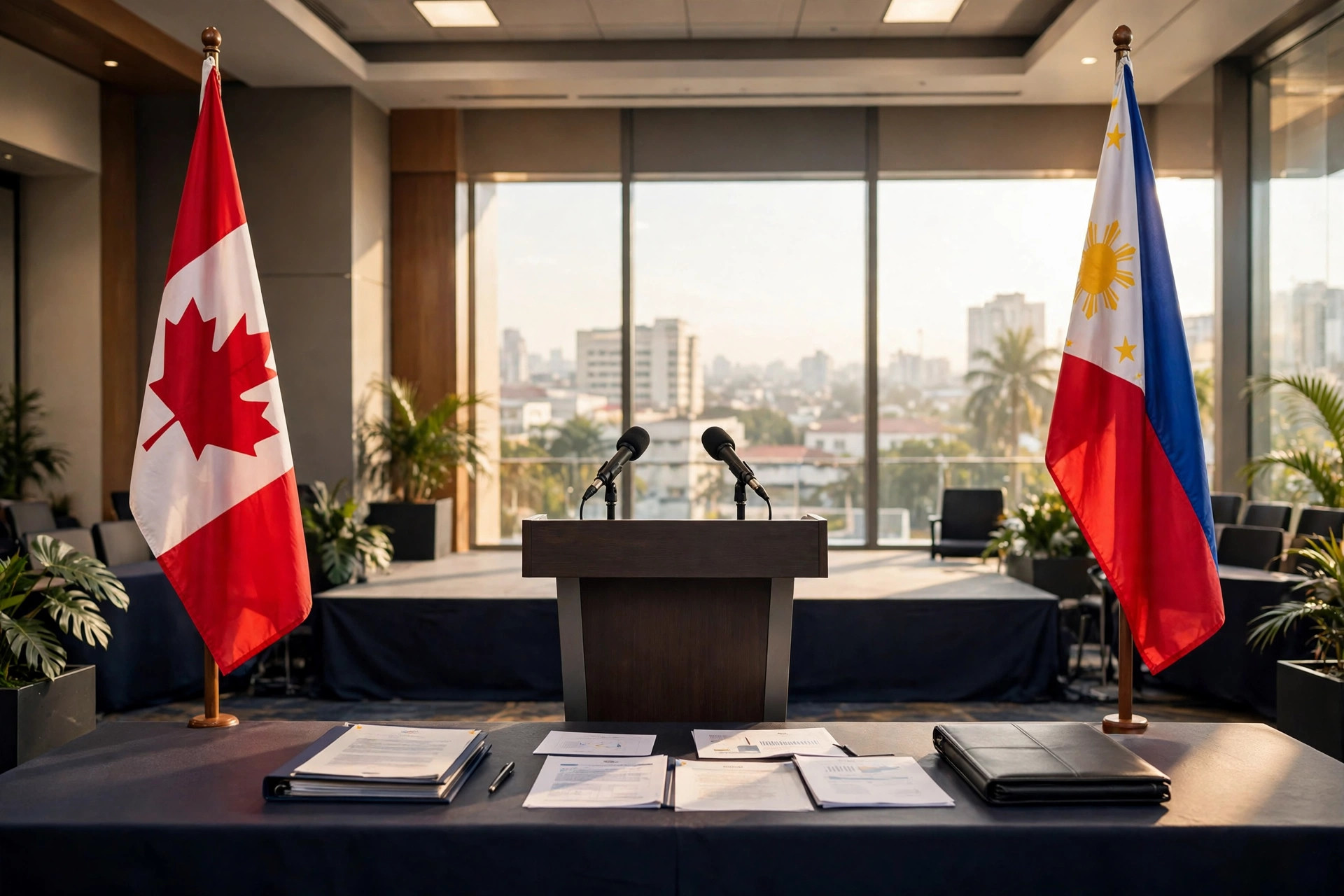
Canadian Prime Minister Mark Carney left Manila on Saturday, 14 November 2026, with two trade announcements that Ottawa presented as the centrepiece of its push to sell more to Asia. The Canada Philippines free trade agreement, negotiated with President Ferdinand Marcos Jr., has had its negotiations concluded, and talks toward a wider ASEAN-Canada free trade agreement have been substantially concluded. Neither pact is signed yet, and neither is in force, but Carney said both could be signed in 2027, with the Philippines deal brought into force next year.
Carney made the announcements in Manila while attending the 49th Association of Southeast Asian Nations (ASEAN) Summit as Guest of the Chair. The timing mattered. Canada has spent much of 2026 trying to reduce its reliance on the United States market during a trade dispute with Washington, and Southeast Asia is the region Ottawa has chosen to court most visibly. The two Manila announcements give Canadian exporters a concrete timetable to watch, even though the detailed product schedules have not been published.
What the Canada Philippines free trade agreement covers
The Canada Philippines free trade agreement would remove tariffs on more than 90 per cent of tariff lines, Carney told reporters in Manila, according to Agence France-Presse. A tariff line is a single product category in a customs schedule, so the figure describes the breadth of the deal rather than the value of trade it covers. The agreement also covers services, investment, digital trade and support for small and medium-sized enterprises, according to the Philippine government briefing reported after the meeting.
Carney described the Canada Philippines free trade agreement as the most comprehensive agreement the Philippines has signed, in remarks reported by Agence France-Presse. The sectors he named were agriculture, aerospace, artificial intelligence, forest products, mining and energy services. Those are areas where Canada already sells into the Philippines: in 2025, two-way merchandise trade between the two countries totalled $3.4 billion, up 7.4 per cent from 2024, according to the Prime Minister's Office. Canada's exports in that trade included mineral ores, meat, cereals, fertilisers and aircraft, while imports from the Philippines included cooking oils, leather and rubber products, The Canadian Press reported.
The Philippines has an economy of $680 billion and a market of more than 110 million people, and the Prime Minister's Office described it as one of the fastest-growing economies in Asia. Ottawa said that once the agreement is in force, it could increase Canadian exports to the Philippines up to three times by 2035. That projection depends on signature, ratification and implementation in both countries, none of which has happened yet.
The ASEAN-Canada deal: a market of nearly 700 million people
The second announcement concerned the ASEAN-Canada Free Trade Agreement, known as ACAFTA. Carney announced the substantial conclusion of negotiations toward that agreement, a step short of full conclusion. Negotiations toward ACAFTA began in 2021, according to the Prime Minister's Office, and the deal would be ASEAN's first trade agreement outside the region, Carney said.
ASEAN has a population of almost 700 million people and an economy of close to $6 trillion, the Prime Minister's Office said. Once in force, the agreement is expected to add nearly $2 billion to Canada's GDP and create nearly 14,000 Canadian jobs, particularly in agriculture and manufacturing. The remaining steps will be completed as quickly as possible, with the ambition of signing the agreement in 2027, the Prime Minister's Office said.
Trade between Canada and ASEAN countries already runs at scale. The Canadian Press reported that two-way trade amounted to $52.3 billion last year, a fifth larger than the previous year. Carney said the ASEAN deal would give Canada access to smaller markets where it does not already have trade agreements, and would ease trade in goods produced across regional borders. He also announced $5 million in assistance to help ensure that every economy across ASEAN has the ability to support the agreement's swift ratification and to benefit from it once in force.
Canada Philippines free trade agreement: what still has to happen before signing in 2027
Concluding negotiations is a milestone, not a finished deal. The Canada Philippines free trade agreement still has to be finalised in legal text, signed by both governments, and then ratified and implemented. Carney said his government would work just as fast to finalise the deal and bring it into force next year, in remarks published by the Prime Minister's Office. The Philippine side has said it expects the pact to be completed in the coming year, Agence France-Presse reported.
Exporters cannot yet see which goods gain and which are carved out, because the negotiated text has not been released and the product-by-product schedules have not been published. One open question concerns pork: the Philippines issued a provisional 60-day suspension of imports covering specified pork products in November 2026, citing preliminary findings of harm to domestic producers, and whether Canada is exempted from Manila's temporary barriers on foreign pork imports remained unresolved at the time of the announcement.
Alongside the trade announcements, Carney announced $26 million in investments to support closer ties between Canada and the Philippines, covering nuclear security and safety, climate-resilient agriculture, community resilience, food security and infrastructure, according to the Prime Minister's Office and The Canadian Press. Three commercial understandings were also announced: a memorandum of understanding between Ocean Supercluster, the Makati Business Club and the University of the Philippines Visayas; one between Draganfly Inc. and Razon Group on Canadian drone technology; and one between JCM Power and the Aurora Pacific Economic Zone Authority.
Carney, Trump and NATO: the wider Manila message
Carney used the same Manila news conference to report on a separate track: trade talks with the United States. He said he had held a lengthy, substantive conversation with President Donald Trump and senior administration officials before leaving for Europe and Asia, and that the two countries are making progress toward a trade deal after negotiations collapsed in August. U.S. Trade Representative Jamieson Greer and White House Chief of Staff Stephen Miller also took part in the call, Carney said.
No agreement has been reached with Washington. After talks collapsed in August, Washington imposed 50 per cent tariffs on about $20 billion in Canadian goods, and Canada responded with retaliatory tariffs in September, the Associated Press reported. Carney said Washington had backed away from demands involving Canada's culture, French-language protections and its ability to negotiate other trade agreements, the Associated Press reported. On the auto sector, his position was blunt: "This government will not settle for a deal with the United States that is not consistent with a viable Canadian auto sector," Carney said, according to The Canadian Press.
That red line connects directly to the Manila deals. Carney has made doubling Canadian exports to countries other than the United States by 2035 a central goal, and the Philippines and ASEAN agreements are the clearest delivery of that strategy so far. Readers following the Washington track can read our earlier report on the Canada-U.S. trade talks after the Carney-Trump call, and the background on U.S.-Canada tariff changes that set the context for the dispute.
Carney also addressed European security in Manila. "There's no way that Canada as a NATO member is going to walk away from any other NATO member — ever," he said, according to The Canadian Press. He added that the security architecture for a free Europe would be determined by a free Europe and NATO, not Russia. The remarks came as European leaders expressed concern about Russia seeking a reordering of continental security in negotiations over Ukraine.
Key facts: the two Manila announcements at a glance
- Canada-Philippines deal: negotiations concluded on 14 November 2026 in Manila; signature targeted for 2027; tariffs to be eliminated on more than 90 per cent of tariff lines; Canadian exports could triple by 2035 if ratified.
- ASEAN-Canada deal (ACAFTA): negotiations substantially concluded; talks began in 2021; market of almost 700 million people; expected to add nearly $2 billion to Canada's GDP and nearly 14,000 jobs once in force; signing ambition is 2027.
- Support money: $5 million to help ASEAN economies ratify the regional deal, and $26 million in investments with the Philippines.
- Trade today: Canada-Philippines merchandise trade was $3.4 billion in 2025; Canada-ASEAN two-way trade was $52.3 billion last year.
- Not yet done: neither agreement is signed or in force, and the negotiated texts have not been published.
What happens next
The next visible steps are legal scrubbing of the texts, formal signature, and domestic approval in Canada, the Philippines and across ASEAN. In Canada, implementing legislation will be needed in Parliament before the Canada Philippines free trade agreement can take effect. In the Philippines, the agreement must be signed, published and ratified. The $5 million in ratification assistance is aimed at the ASEAN side, where several smaller economies must each complete their own domestic steps.
For Canadian businesses, the practical test will be the tariff schedules once they are published: which farm goods, forest products, manufactured items and services actually gain preferential access, and what rules of origin apply. For the government, the test is whether the 2027 signature target holds, and whether the U.S. talks produce a separate deal that protects the auto sector Carney has called non-negotiable. The Manila announcements show the direction of Canadian trade policy; the signatures, the schedules and the ratifications will show whether it delivers. The fiscal backdrop at home is covered in our report on the Canada budget due in November 2026.